import matplotlib.pyplot as pltimport numpy as npimport torchimport bofire.strategies.api as strategiesfrom bofire.benchmarks.api import DTLZ2from bofire.data_models.objectives import api as objectives_data_modelfrom bofire.data_models.strategies import api as strategies_data_model
/opt/hostedtoolcache/Python/3.12.15/x64/lib/python3.12/site-packages/torch/jit/_script.py:1491: FutureWarning: `torch.jit.script` is deprecated. Please switch to `torch.compile` or `torch.export`.
  warnings.warn(
/opt/hostedtoolcache/Python/3.12.15/x64/lib/python3.12/site-packages/torch/jit/_script.py:1491: FutureWarning: `torch.jit.script` is deprecated. Please switch to `torch.compile` or `torch.export`.
  warnings.warn(
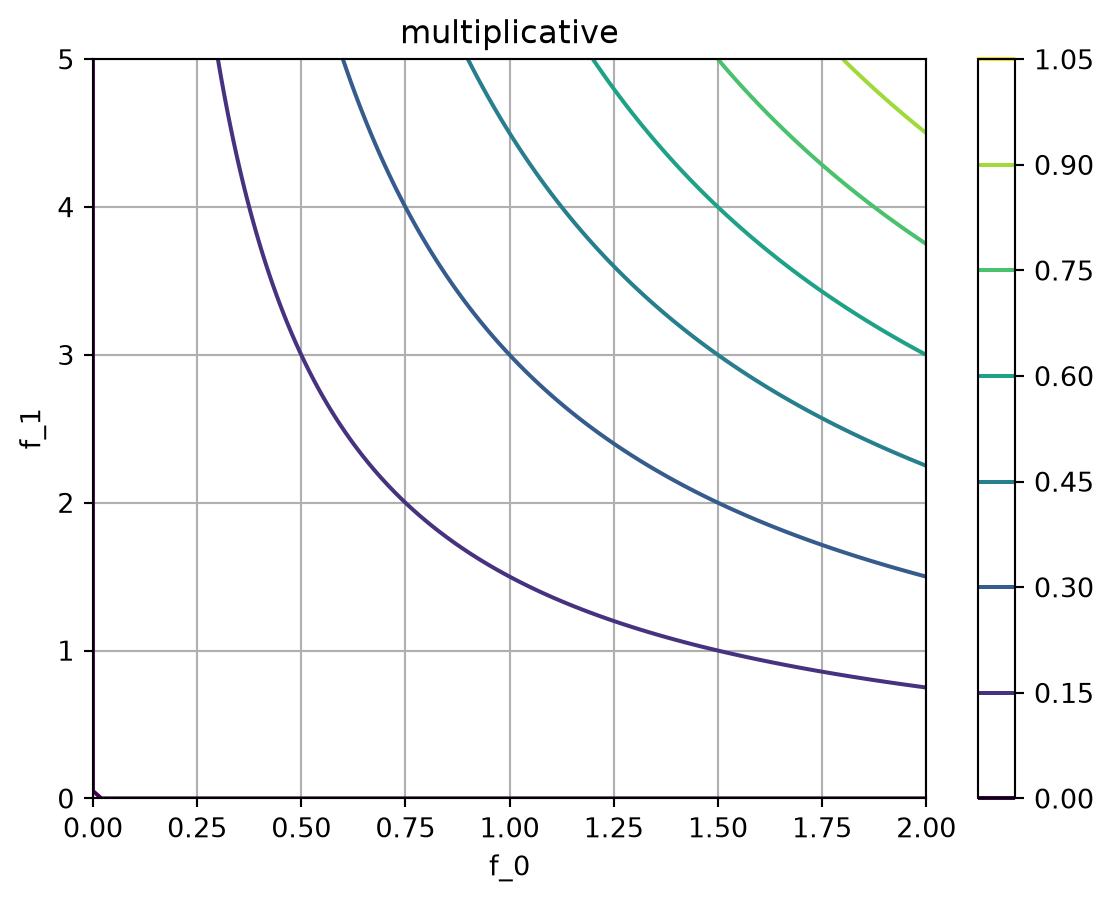
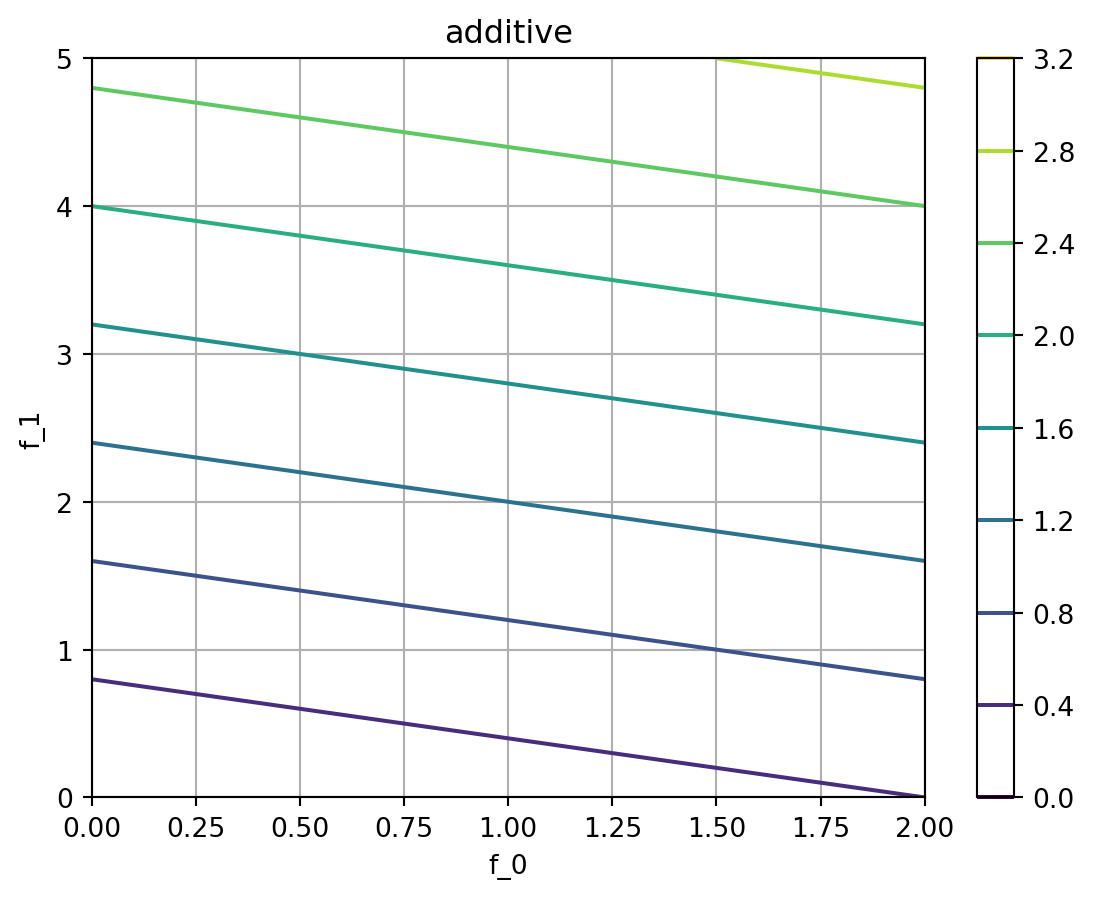
We will use pure multiplicative and additive Sobo strategies, as well as a mixed one for this example: - Multiplicative: \(f = f_0^{w_0} \cdot f_1^{w_1}\) - Additive: \(f = f_0 \cdot w_0 + f_1 \cdot w_1\) - Mixed (with f1 being the additive objective): \(f = f_0^{w_0} \cdot (1 + w_1 \cdot f_1)\)
We will now create the strategies and evaluate them on a grid to visualize the objectives.
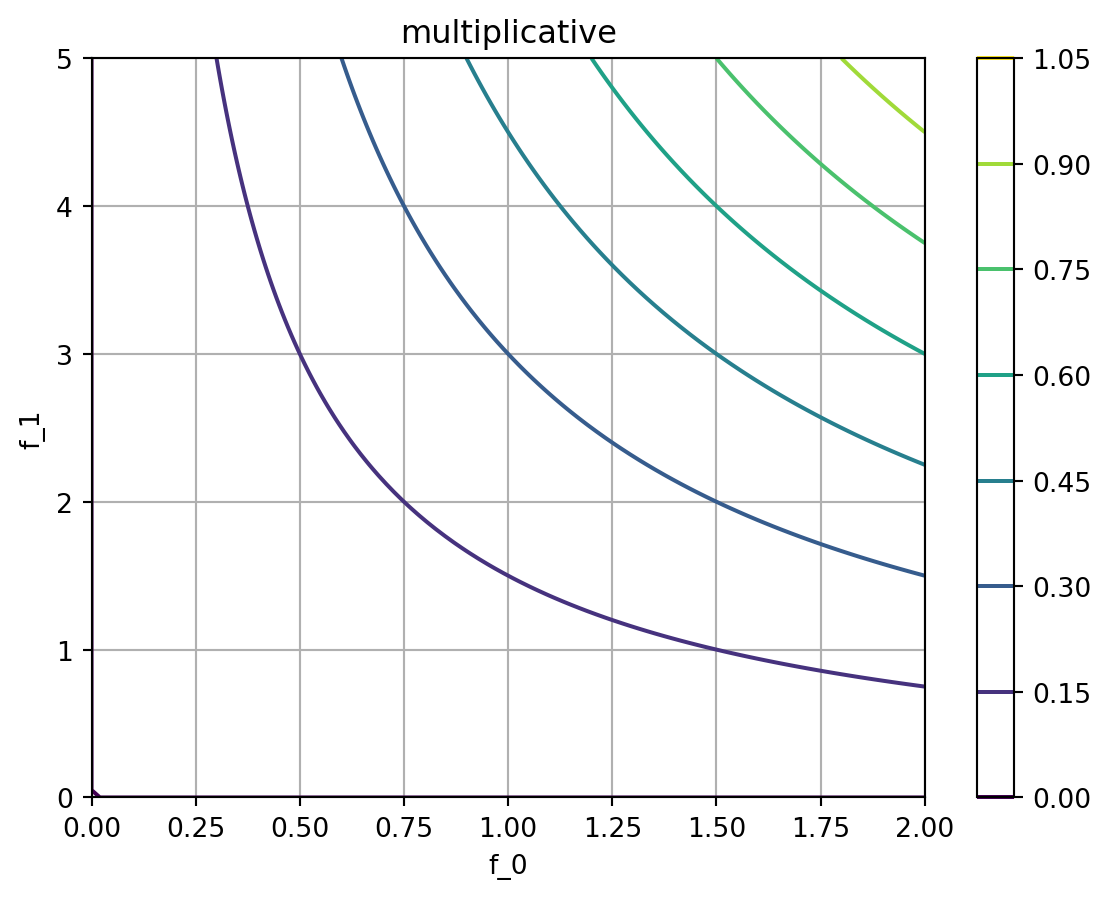
We see the following: - Multiplicative: The objective is a product of the objectives: If either \(f_0\) or \(f_1\) is low, the objective is low. - Additive: The objective is a sum of the objectives: We see a linear increase in the objective with increasing \(f_0\) and \(f_1\). This is useful for complementary objectives. - Mixed: The objective is more strict w.r.t. \(f_0\) than the additive objective \(f_1\). The overall desirability can also be high, if \(f_1\) is low.
Changing the weights \(w_i\) in the objectives above will further change the preference of \(f_0\) and \(f_1\).
# map from the strategy data-model to the actual strategy object instancesstrategy = { key: strategies.map(strategy_data_model)for (key, strategy_data_model) in strategy_data_model.items()}
# tell the strategies about the experiments. This is required to set up the models, but not for the objective evaluationfor _, strat in strategy.items(): strat.tell(experiments)
/opt/hostedtoolcache/Python/3.12.15/x64/lib/python3.12/site-packages/bofire/utils/torch_tools.py:51: UserWarning: The given NumPy array is not writable, and PyTorch does not support non-writable tensors. This means writing to this tensor will result in undefined behavior. You may want to copy the array to protect its data or make it writable before converting it to a tensor. This type of warning will be suppressed for the rest of this program. (Triggered internally at /__w/pytorch/pytorch/torch/csrc/utils/tensor_numpy.cpp:213.)
  return torch.from_numpy(np.ascontiguousarray(df.to_numpy())).to(**tkwargs)
# get the objectives for evaluation as a torch executableobjectives = { key: strategy._get_objective_and_constraints()[0]for (key, strategy) in strategy.items()}
# f_0 / f_1 coordinates for objctive evaluationmesh = np.meshgrid(np.linspace(0, 2, 100), np.linspace(0, 5, 100))# transform to matrix-form torch tensormesh_tensor = torch.tensor([m.flatten() for m in mesh]).T
/tmp/ipykernel_2962/1215888523.py:4: UserWarning: Creating a tensor from a list of numpy.ndarrays is extremely slow. Please consider converting the list to a single numpy.ndarray with numpy.array() before converting to a tensor. (Triggered internally at /__w/pytorch/pytorch/torch/csrc/utils/tensor_new.cpp:252.)
  mesh_tensor = torch.tensor([m.flatten() for m in mesh]).T
# plot the objectives as contour plotsfor key, obj in objectives_eval.items(): plt.figure() plt.contour(*mesh, obj, label=key) plt.title(key) plt.xlabel("f_0") plt.ylabel("f_1") plt.grid(True) plt.colorbar()plt.show()
Source Code
---title: Merging Objectivesjupyter: python3---```{python}import matplotlib.pyplot as pltimport numpy as npimport torchimport bofire.strategies.api as strategiesfrom bofire.benchmarks.api import DTLZ2from bofire.data_models.objectives import api as objectives_data_modelfrom bofire.data_models.strategies import api as strategies_data_model```## Benchmark ProblemOnly used for domain definition```{python}bench = DTLZ2(dim=2, num_objectives=2)experiments = bench.f(bench.domain.inputs.sample(10), return_complete=True)domain = bench.domain```### Change the objectives: Multiplication, only reasonable for objectives > 0```{python}outputs = domain.outputs.get_by_objective()outputs[0].objective = objectives_data_model.MaximizeObjective(w=1.0, bounds=(0.0, 5.0))outputs[1].objective = objectives_data_model.MaximizeObjective(w=1.0, bounds=(0.0, 2.0))# outputs[1].objective = objectives_data_model.MaximizeSigmoidObjective(w = 0.5, tp=2.5, steepness=3.)```## Select StrategiesWe will use pure multiplicative and additive Sobo strategies, as well as a mixed one for this example:- Multiplicative: $f = f_0^{w_0} \cdot f_1^{w_1}$- Additive: $f = f_0 \cdot w_0 + f_1 \cdot w_1$- Mixed (with f1 being the additive objective): $f = f_0^{w_0} \cdot (1 + w_1 \cdot f_1)$```{python}strategy_data_model = {"multiplicative": strategies_data_model.MultiplicativeSoboStrategy(domain=domain),"additive": strategies_data_model.AdditiveSoboStrategy(domain=domain),"mixed": strategies_data_model.MultiplicativeAdditiveSoboStrategy( domain=domain, additive_features=["f_1"] ),}```### We will now create the strategies and evaluate them on a grid to visualize the objectives.We see the following:- Multiplicative: The objective is a product of the objectives: If either $f_0$ or $f_1$ is low, the objective is low.- Additive: The objective is a sum of the objectives: We see a linear increase in the objective with increasing $f_0$ and $f_1$. This is useful for complementary objectives.- Mixed: The objective is more strict w.r.t. $f_0$ than the additive objective $f_1$. The overall desirability can also be high, if $f_1$ is low.Changing the weights $w_i$ in the objectives above will further change the preference of $f_0$ and $f_1$.```{python}# map from the strategy data-model to the actual strategy object instancesstrategy = { key: strategies.map(strategy_data_model)for (key, strategy_data_model) in strategy_data_model.items()}``````{python}# tell the strategies about the experiments. This is required to set up the models, but not for the objective evaluationfor _, strat in strategy.items(): strat.tell(experiments)``````{python}# get the objectives for evaluation as a torch executableobjectives = { key: strategy._get_objective_and_constraints()[0]for (key, strategy) in strategy.items()}``````{python}# f_0 / f_1 coordinates for objctive evaluationmesh = np.meshgrid(np.linspace(0, 2, 100), np.linspace(0, 5, 100))# transform to matrix-form torch tensormesh_tensor = torch.tensor([m.flatten() for m in mesh]).T``````{python}# evaluate objectivesobjectives_eval = { key: obj(mesh_tensor).detach().numpy().reshape(mesh[0].shape)for (key, obj) in objectives.items()}``````{python}# plot the objectives as contour plotsfor key, obj in objectives_eval.items(): plt.figure() plt.contour(*mesh, obj, label=key) plt.title(key) plt.xlabel("f_0") plt.ylabel("f_1") plt.grid(True) plt.colorbar()plt.show()```