---
title: Transfer Learning BO
jupyter: python3
---
```{python}
#| papermill: {duration: 2.980124, end_time: '2024-10-10T20:34:18.797038', exception: false, start_time: '2024-10-10T20:34:15.816914', status: completed}
#| tags: []
import os

import numpy as np
import pandas as pd
from tqdm import tqdm

import bofire.strategies.api as strategies
import bofire.surrogates.api as surrogates
from bofire.benchmarks.api import Ackley, Branin
from bofire.data_models.acquisition_functions.api import qLogEI
from bofire.data_models.domain.api import Domain, Inputs, Outputs
from bofire.data_models.features.api import ContinuousInput, ContinuousOutput, CategoricalTaskInput
from bofire.data_models.objectives.api import MaximizeObjective
from bofire.data_models.strategies.api import SoboStrategy
from bofire.data_models.surrogates.api import (
    BotorchSurrogates,
    MultiTaskGPSurrogate,
    SingleTaskGPSurrogate,
)
```
```{python}
#| papermill: {duration: 0.262804, end_time: '2024-10-10T20:34:19.062415', exception: false, start_time: '2024-10-10T20:34:18.799611', status: completed}
#| tags: []
import matplotlib.pyplot as plt
```
In this notebook we show how to use BoFire for the purposes of transfer learning Bayesian optimization. In particular, we assume we have a task $f_2$ with data that is relevant to the optimization of our current task $f_1$. The procedure is simple, we fit a MultiTask GP to both data-sets, however only carry out the BO on $f_1$, i.e., we optimize the acquisition functions on on the task $f_1$.
We build a small data-set using the target task:
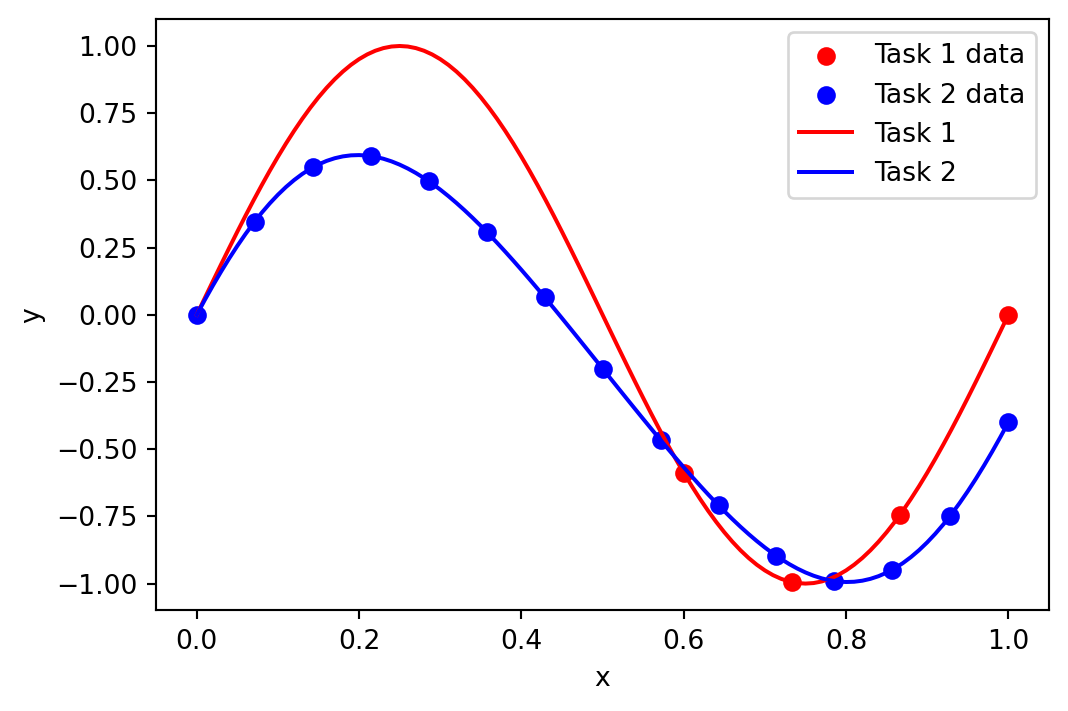
$$ f_1(x) = \sin(2 \pi x) $$
And we will have data the second related task:
$$ f_2 = 0.9 \sin(2 \pi x) + 0.2 \cos(3 \pi x) - 0.2 $$
We begin by defining the functions, generating some data, and plotting it. We generate 15 data-points for Task 2 and just 4 data-points for Task 1, all the data-points in Task 1 will be in a restricted area of the space.
```{python}
#| papermill: {duration: 0.663407, end_time: '2024-10-10T20:34:19.732148', exception: false, start_time: '2024-10-10T20:34:19.068741', status: completed}
#| tags: []
def task_1_f(x):
    return np.sin(x * 2 * np.pi)


def task_2_f(x):
    return 0.9 * np.sin(x * 2 * np.pi) - 0.2 + 0.2 * np.cos(x * 3 * np.pi)


x = np.linspace(0, 1, 101)

# generate lots of low fidelity data and a few high fidelity data

task_1_x = np.linspace(0.6, 1, 4)
task_1_y = task_1_f(task_1_x)

task_2_x = np.linspace(0, 1, 15)
task_2_y = task_2_f(task_2_x)

# set the data in the pandas format
experiments = pd.DataFrame(
    {
        "x": np.concatenate([task_1_x, task_2_x]),
        "y": np.concatenate([task_1_y, task_2_y]),
        "task": ["task_1"] * len(task_1_x) + ["task_2"] * len(task_2_x),
    },
)

plt.figure(figsize=(6, 4))

plt.scatter(task_1_x, task_1_y, label="Task 1 data", color="red")
plt.scatter(task_2_x, task_2_y, label="Task 2 data", color="blue")

plt.plot(x, task_1_f(x), label="Task 1", color="red")
plt.plot(x, task_2_f(x), label="Task 2", color="blue")

plt.xlabel("x")
plt.ylabel("y")

plt.legend()
```
# Inference
At first we will show to do inference with the model and see make predictions using multiple data-sets.
We first set-up the model according to BoFire's API, by defining the set of input and output features and the corresponding bounds, and create a surrogate data model:
- To define the task we choose the `CategoricalTaskInput` feature, everything else follows standard BoFire procedure.
```{python}
#| papermill: {duration: 0.006739, end_time: '2024-10-10T20:34:19.750236', exception: false, start_time: '2024-10-10T20:34:19.743497', status: completed}
#| tags: []
# set-up the task model with allowed variable as ["True"] for the target task and ["False"] for the other task
task_input = CategoricalTaskInput(key="task", categories=["task_1", "task_2"])
# define the input features
input_features = [ContinuousInput(key="x", bounds=(0, 1)), task_input]

objective = MaximizeObjective(w=1)
output_features = [ContinuousOutput(key="y", objective=objective)]

inputs = Inputs(features=input_features)
outputs = Outputs(features=output_features)

surrogate_data = MultiTaskGPSurrogate(inputs=inputs, outputs=outputs)
```
We map from the surrogate data into the surrogate model and fit the data.
```{python}
#| papermill: {duration: 0.152004, end_time: '2024-10-10T20:34:19.909174', exception: true, start_time: '2024-10-10T20:34:19.757170', status: failed}
#| tags: []
surrogate = surrogates.map(surrogate_data)

surrogate.fit(experiments)
```
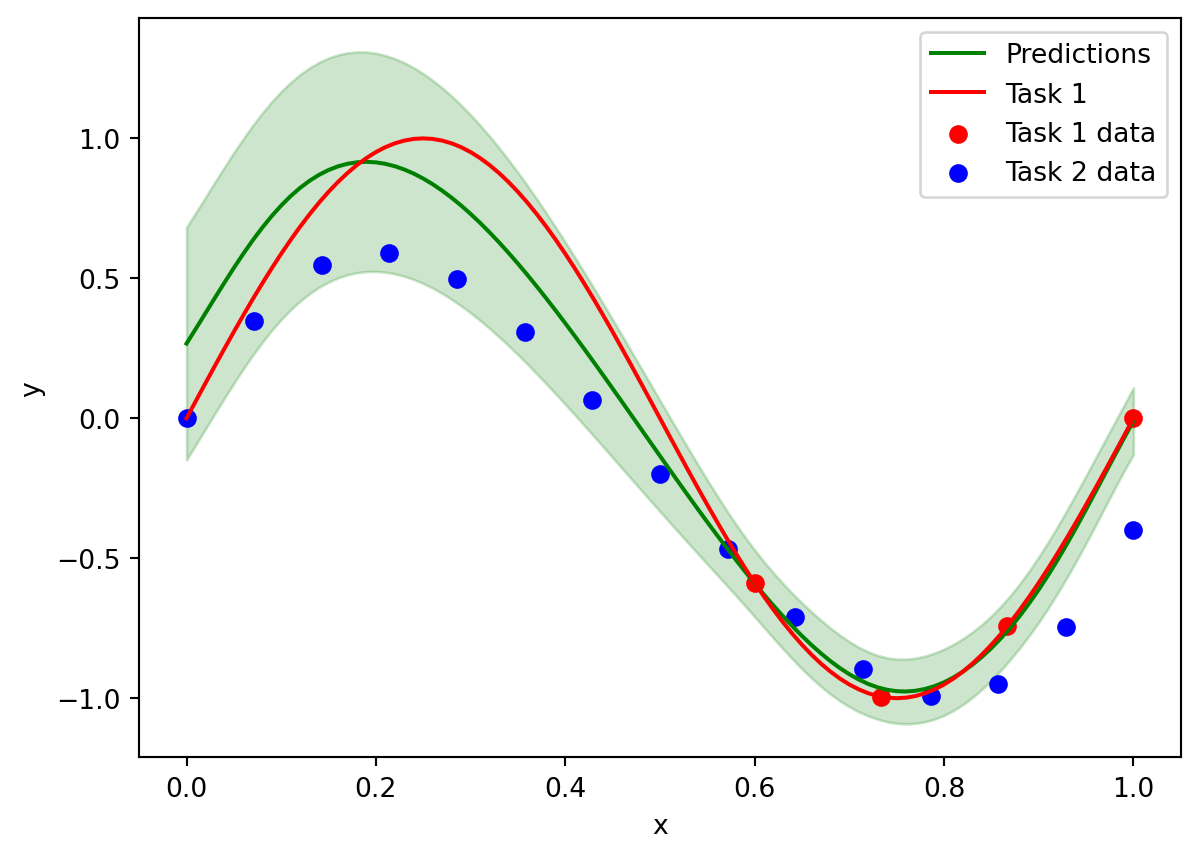
Plot to see how we are able to predict outside of the region where there is data for Task 1, since we can use the data from Task 2 and the learnt correlations:
```{python}
#| papermill: {duration: null, end_time: null, exception: null, start_time: null, status: pending}
#| tags: []
# predict the high fidelity data
x_predict = np.linspace(0, 1, 101)
y_predict = surrogate.predict(
    pd.DataFrame({"x": x_predict, "task": ["task_1"] * len(x_predict)}),
)

# plot data and predictions
plt.plot(x_predict, y_predict["y_pred"], label="Predictions", color="green")
plt.fill_between(
    x_predict,
    y_predict["y_pred"] - 2 * y_predict["y_sd"],
    y_predict["y_pred"] + 2 * y_predict["y_sd"],
    color="green",
    alpha=0.2,
)

# plot the high fidelity function
plt.plot(x, task_1_f(x), label="Task 1", color="red")

# plot the data too
plt.scatter(
    experiments[experiments["task"] == "task_1"]["x"],
    experiments[experiments["task"] == "task_1"]["y"],
    label="Task 1 data",
    color="red",
)
plt.scatter(
    experiments[experiments["task"] == "task_2"]["x"],
    experiments[experiments["task"] == "task_2"]["y"],
    label="Task 2 data",
    color="blue",
)

plt.xlabel("x")
plt.ylabel("y")

plt.legend()
```
# Transfer Learning Bayesian Optimisation
Let us now integrate this into BoFire's `SOBO` strategy. This can be done by following the standard BoFire syntax with a small modification.
- For `TaskInput` we must set the variable `allowed` as a list, with each element in the list corresponding to one of the `categories` such that all auxiliary tasks have `False` and target task has `True`. For example, we have `categories = ["task_1, task_2"]` and the goal of our optimization is to optimize `task_1` therefore we set `allowed = [True, False]`:
```{python}
#| papermill: {duration: null, end_time: null, exception: null, start_time: null, status: pending}
#| tags: []
input_features = [
    ContinuousInput(key="x", bounds=(0, 1)),
    CategoricalTaskInput(key="task", categories=["task_1", "task_2"], allowed=[True, False]),
]

objective = MaximizeObjective(w=1)
output_features = [ContinuousOutput(key="y", objective=objective)]

inputs = Inputs(features=input_features)
outputs = Outputs(features=output_features)

surrogate_data = MultiTaskGPSurrogate(inputs=inputs, outputs=outputs)
surrogate_specs = BotorchSurrogates(surrogates=[surrogate_data])

# define the acquisition function
acquisition = qLogEI()

sobo_strategy_data_model = SoboStrategy(
    domain=Domain(
        inputs=inputs,
        outputs=outputs,
    ),
    acquisition_function=acquisition,
    surrogate_specs=surrogate_specs,
)

sobo_strategy = strategies.map(sobo_strategy_data_model)

sobo_strategy.tell(experiments)
```
We can now generate experimental candidates:
```{python}
#| papermill: {duration: null, end_time: null, exception: null, start_time: null, status: pending}
#| tags: []
candidates = sobo_strategy.ask(3)

candidates
```
If we instead wanted to optimize `task_2` instead of `task_1`, we simply change `allowed = [False, True]`:
```{python}
#| papermill: {duration: null, end_time: null, exception: null, start_time: null, status: pending}
#| tags: []
input_features = [
    ContinuousInput(key="x", bounds=(0, 1)),
    CategoricalTaskInput(key="task", categories=["task_1", "task_2"], allowed=[False, True]),
]

objective = MaximizeObjective(w=1)
output_features = [ContinuousOutput(key="y", objective=objective)]

inputs = Inputs(features=input_features)
outputs = Outputs(features=output_features)

surrogate_data = MultiTaskGPSurrogate(inputs=inputs, outputs=outputs)
surrogate_specs = BotorchSurrogates(surrogates=[surrogate_data])

# define the acquisition function
acquisition = qLogEI()

sobo_strategy_data_model = SoboStrategy(
    domain=Domain(
        inputs=inputs,
        outputs=outputs,
    ),
    acquisition_function=acquisition,
    surrogate_specs=surrogate_specs,
)

sobo_strategy = strategies.map(sobo_strategy_data_model)

sobo_strategy.tell(experiments)
```
We now obtain candidates for `task_2`:
```{python}
#| papermill: {duration: null, end_time: null, exception: null, start_time: null, status: pending}
#| tags: []
candidate = sobo_strategy.ask(1)

candidate
```
Let us now run a Bayesian optimization loop on the Branin benchmark to show the usefulness of transfer learning Bayesian optimization in a practical setting. We create a small data-set composed of the Branin benchmark itself, and a large one composed of the Branin function with a small amount of bias added by summing the Branin and Ackley functions.
We begin by defining a function that creates random initial data-sets, and create as many data-sets as the number of runs we want to average over:
```{python}
#| papermill: {duration: null, end_time: null, exception: null, start_time: null, status: pending}
#| tags: []
benchmark = Branin()
bias = Ackley()


def create_data_set():
    # choose the initial data-sets
    low_fidelity_x = benchmark.domain.inputs.sample(25)
    high_fidelity_x = benchmark.domain.inputs.sample(4)

    # create the observations
    high_fidelity_data = benchmark.f(high_fidelity_x, return_complete=True)
    low_fidelity_bias = bias.f(low_fidelity_x, return_complete=True)

    low_fidelity_data = benchmark.f(low_fidelity_x, return_complete=True)
    low_fidelity_data["y"] = low_fidelity_data["y"] + 0.15 * low_fidelity_bias["y"]

    # create a joint data-set, with the task variable
    high_fidelity_data["task"] = "task_1"
    low_fidelity_data["task"] = "task_2"

    experiments_joint = pd.concat([low_fidelity_data, high_fidelity_data])

    return high_fidelity_data, experiments_joint
```
```{python}
#| papermill: {duration: null, end_time: null, exception: null, start_time: null, status: pending}
#| tags: []
single_task_all_regrets = []

SMOKE_TEST = os.environ.get("SMOKE_TEST")
if SMOKE_TEST:
    num_runs = 5
    num_iters = 2
    verbose = False
else:
    num_runs = 10
    num_iters = 10
    verbose = True

# create the initial data-sets for each run

high_fidelity_datasets = []
experiments_joint_datasets = []

for _ in range(num_runs):
    high_fidelity_data, experiments_joint = create_data_set()
    high_fidelity_datasets.append(high_fidelity_data)
    experiments_joint_datasets.append(experiments_joint)
```
Let us now run a Bayesian optimization loop only using the high-fidelity data:
```{python}
#| papermill: {duration: null, end_time: null, exception: null, start_time: null, status: pending}
#| tags: []
for run in range(num_runs):
    high_fidelity_data = high_fidelity_datasets[run]

    inputs = benchmark.domain.inputs
    outputs = benchmark.domain.outputs

    surrogate_data = SingleTaskGPSurrogate(inputs=inputs, outputs=outputs)
    surrogate_specs = BotorchSurrogates(surrogates=[surrogate_data])

    acquisition = qLogEI()

    sobo_strategy_data_model = SoboStrategy(
        domain=Domain(
            inputs=inputs,
            outputs=outputs,
        ),
        acquisition_function=acquisition,
        surrogate_specs=surrogate_specs,
    )

    sobo_strategy = strategies.map(sobo_strategy_data_model)

    dataset = high_fidelity_data.drop(columns=["task"])

    sobo_strategy.tell(dataset)

    regrets_single_task = []

    init_regret = (
        sobo_strategy.experiments["y"][sobo_strategy.experiments["y"].argmin()]
        - benchmark.get_optima()["y"][0].item()
    )
    regrets_single_task.append(init_regret)

    pbar = tqdm(range(num_iters), desc="Optimizing")
    for _iter in pbar:
        candidate = sobo_strategy.ask(1)
        y = benchmark.f(candidate, return_complete=True)
        sobo_strategy.tell(y)

        regret = (
            sobo_strategy.experiments["y"][sobo_strategy.experiments["y"].argmin()]
            - benchmark.get_optima()["y"][0].item()
        )
        regrets_single_task.append(regret)

        pbar.set_postfix({"Regret": f"{regret:.4f}"})

    single_task_all_regrets.append(regrets_single_task)
```
We now repeat the experiment but using transfer learning BO:
```{python}
#| papermill: {duration: null, end_time: null, exception: null, start_time: null, status: pending}
#| tags: []
multitask_all_regrets = []

for run in range(num_runs):
    experiments_joint = experiments_joint_datasets[run]

    input_features = benchmark.domain.inputs.features + [
        CategoricalTaskInput(key="task", categories=["task_1", "task_2"], allowed=[True, False]),
    ]
    inputs = Inputs(features=input_features)
    outputs = benchmark.domain.outputs

    surrogate_data = MultiTaskGPSurrogate(inputs=inputs, outputs=outputs)
    surrogate_specs = BotorchSurrogates(surrogates=[surrogate_data])

    acquisition = qLogEI()

    sobo_strategy_data_model = SoboStrategy(
        domain=Domain(
            inputs=inputs,
            outputs=outputs,
        ),
        acquisition_function=acquisition,
        surrogate_specs=surrogate_specs,
    )

    sobo_strategy = strategies.map(sobo_strategy_data_model)

    dataset = experiments_joint.copy()

    sobo_strategy.tell(dataset)

    regrets_transfer_learning = []

    # obtain experiments at the highest fidelity
    experiments = sobo_strategy.experiments[
        sobo_strategy.experiments["task"] == "task_1"
    ]["y"]
    init_regret = (
        experiments[experiments.argmin()] - benchmark.get_optima()["y"][0].item()
    )
    regrets_transfer_learning.append(init_regret)

    pbar = tqdm(range(num_iters), desc="Optimizing")
    for _iter in pbar:
        candidate = sobo_strategy.ask(1)
        candidate = candidate.drop(columns=["task"])
        y = benchmark.f(candidate, return_complete=True)
        y["task"] = "task_1"
        sobo_strategy.tell(y)

        experiments = sobo_strategy.experiments[
            sobo_strategy.experiments["task"] == "task_1"
        ]["y"].reset_index(drop=True)
        regret = (
            experiments[experiments.argmin()] - benchmark.get_optima()["y"][0].item()
        )
        regrets_transfer_learning.append(regret)

        pbar.set_postfix({"Regret": f"{regret:.4f}"})

    multitask_all_regrets.append(regrets_transfer_learning)
```
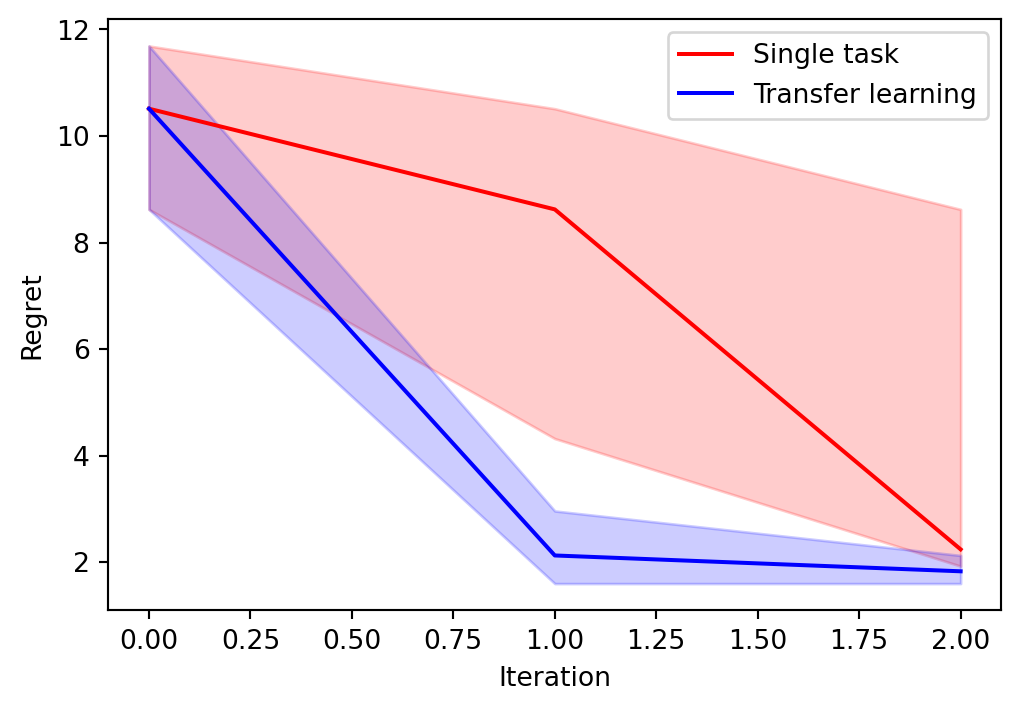
We now plot the quantiles and median simple regret against iteration:
```{python}
#| papermill: {duration: null, end_time: null, exception: null, start_time: null, status: pending}
#| tags: []
# plot the results
plt.figure(figsize=(6, 4))

regrets_single_task_median = np.median(np.array(single_task_all_regrets), axis=0)
regrets_transfer_learning_median = np.median(np.array(multitask_all_regrets), axis=0)

# get the 25 and 75 percentiles
regrets_single_task_upper_quantile = np.quantile(
    np.array(single_task_all_regrets),
    0.75,
    axis=0,
)
regrets_single_task_lower_quantile = np.quantile(
    np.array(single_task_all_regrets),
    0.25,
    axis=0,
)

regrets_transfer_learning_upper_quantile = np.quantile(
    np.array(multitask_all_regrets),
    0.75,
    axis=0,
)
regrets_transfer_learning_lower_quantile = np.quantile(
    np.array(multitask_all_regrets),
    0.25,
    axis=0,
)

plt.plot(regrets_single_task_median, label="Single task", color="red")
plt.plot(regrets_transfer_learning_median, label="Transfer learning", color="blue")

plt.fill_between(
    np.arange(num_iters + 1),
    regrets_single_task_upper_quantile,
    regrets_single_task_lower_quantile,
    color="red",
    alpha=0.2,
)
plt.fill_between(
    np.arange(num_iters + 1),
    regrets_transfer_learning_upper_quantile,
    regrets_transfer_learning_lower_quantile,
    color="blue",
    alpha=0.2,
)

plt.xlabel("Iteration")
plt.ylabel("Regret")

plt.legend()

plt.show()
```
We can see that using transfer learning leads to significant improvement.