---
title: Outlier Detection and Robust GP
jupyter: python3
---
This notebook shows how to use a robust single-task GP (`SingleTaskGPSurrogate.robust`, a single-task GP with a `SparseOutlierGaussianLikelihood`) in Bofire to autmomatically detect outliers in your data and/or fit Gaussian process models robust to outliers.
It is based on the [Robust Gaussian Processes via Relevance Pursuit](https://arxiv.org/pdf/2410.24222) paper and is based on the accompanying implementation and tutorial in [BoTorch](https://botorch.org/docs/tutorials/relevance_pursuit_robust_regression/)
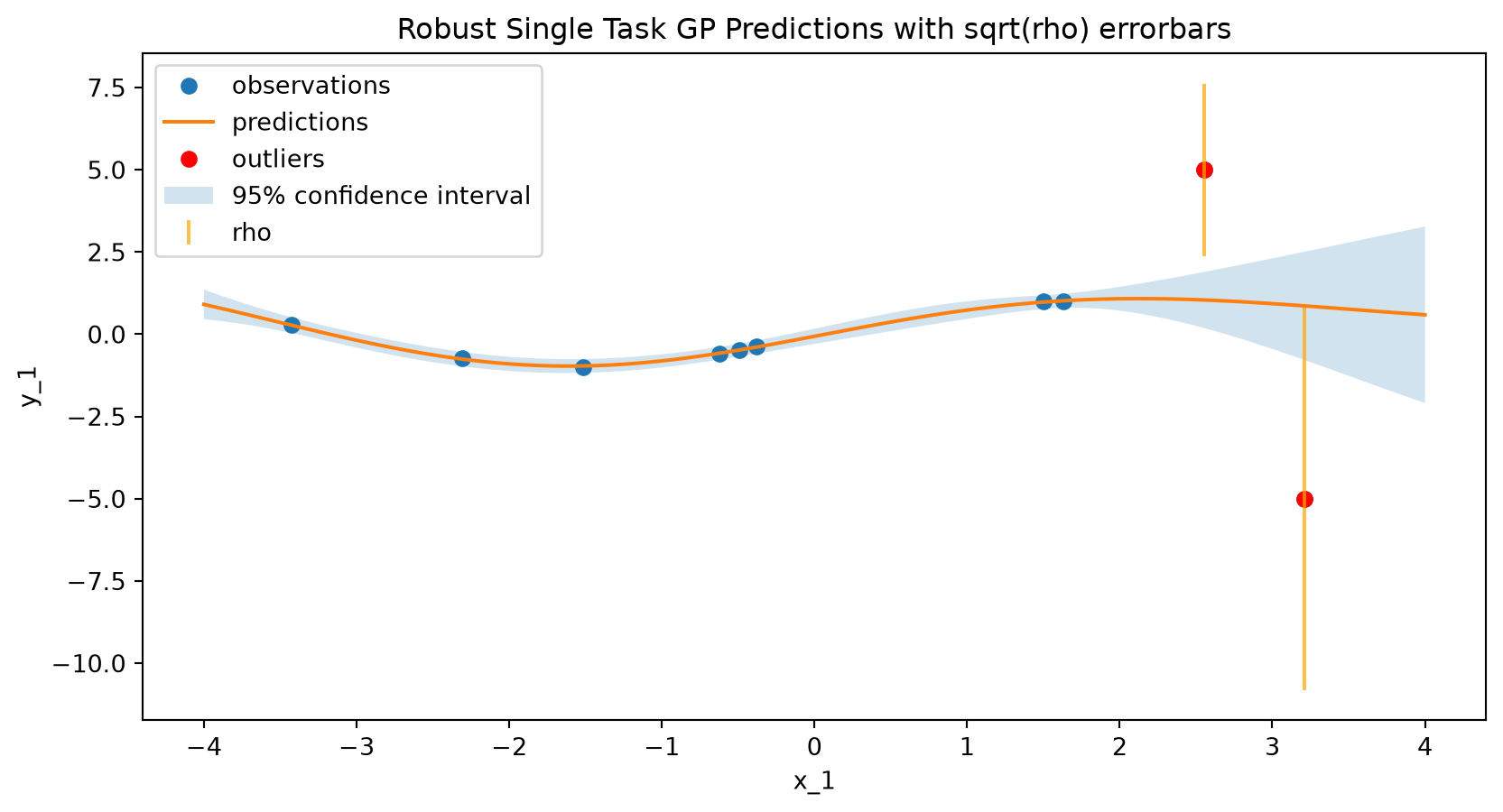
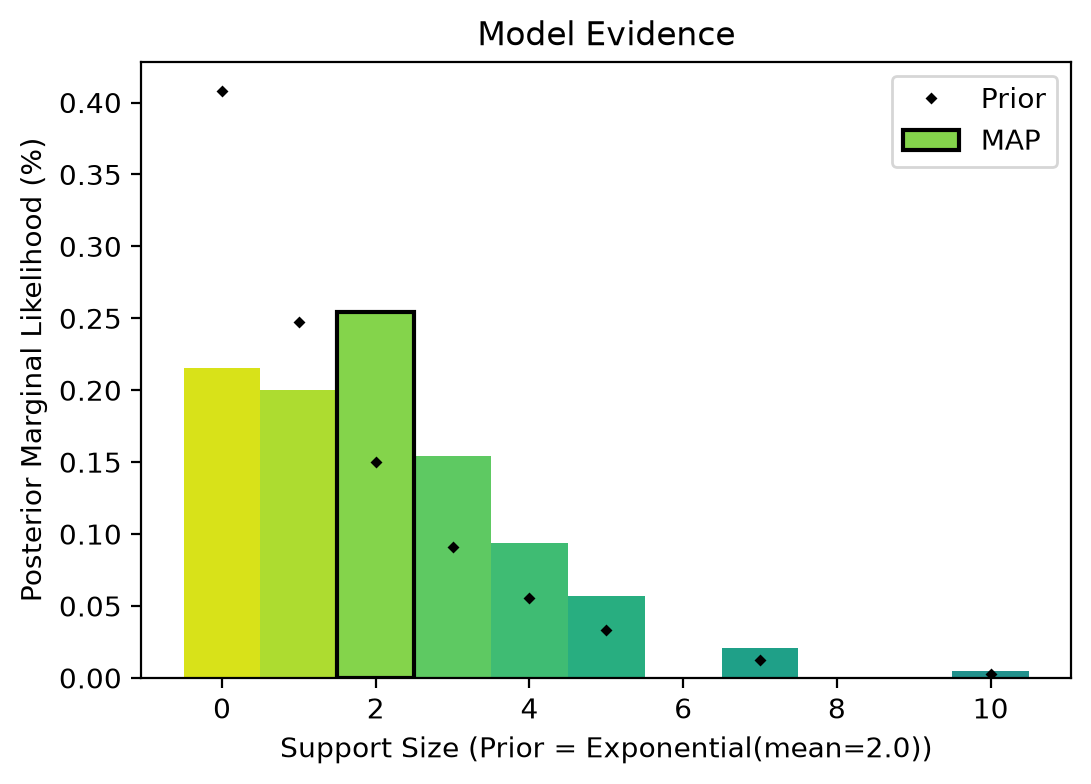
In this approach, the typical GP observation noise $\sigma^2$ is extended with data-point-specific noise variances $\rho$. A prior distribution is placed over the number of outliers $S$, and through a sequential greedy optimization algorithm (see for details the links above) a list of models with variying sparsity levels $|S|$ are obtained. The most promising model can then be selected through Bayesian model selection.
This tutorial will show how to use the model, how to obtain the data-point specific noise levels, and how to obtain the full model trace.
### Imports
```{python}
# Model imports
import matplotlib.pyplot as plt
import numpy as np
import pandas as pd
import torch
from torch import Tensor

import bofire.surrogates.api as surrogates
from bofire.data_models.domain.api import Inputs, Outputs
from bofire.data_models.features.api import ContinuousInput, ContinuousOutput
from bofire.data_models.surrogates.api import SingleTaskGPSurrogate
```
### Setting up a Synthetic example
```{python}
input_features = Inputs(
    features=[ContinuousInput(key=f"x_{i+1}", bounds=(-4, 4)) for i in range(1)],
)
output_features = Outputs(features=[ContinuousOutput(key="y_1")])

experiments = input_features.sample(n=10)
experiments["y_1"] = np.sin(experiments["x_1"])

experiments["valid_y_1"] = 1
experiments["valid_y_2"] = 1

# prediction grid
x = pd.DataFrame(pd.Series(np.linspace(-4, 4, 100), name="x_1"))
```
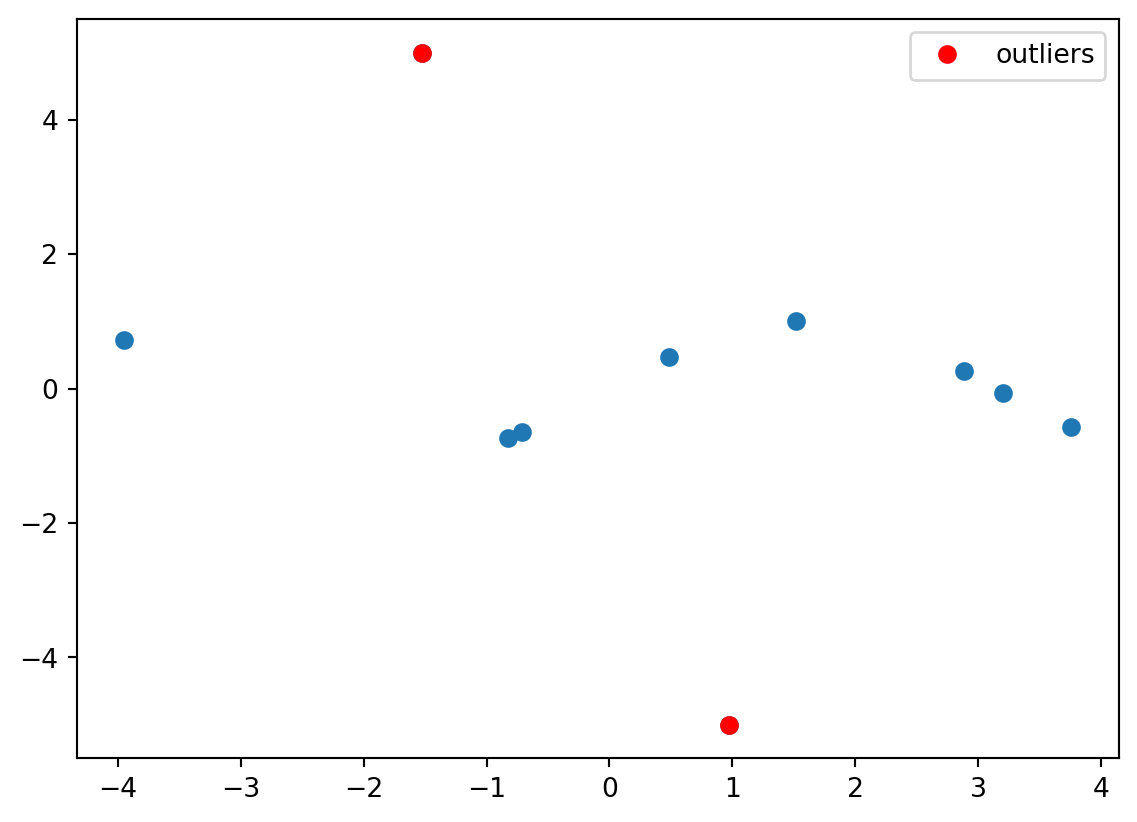
### Let's add two clear outliers
```{python}
experiments.loc[0, "y_1"] = 5
experiments.loc[1, "y_1"] = -5
```
```{python}
plt.plot(experiments["x_1"], experiments["y_1"], "o")

# plot the last two points in red
plt.plot(
    experiments["x_1"].iloc[:2],
    experiments["y_1"].iloc[:2],
    "ro",
    label="outliers",
)

plt.legend()
plt.show()
```
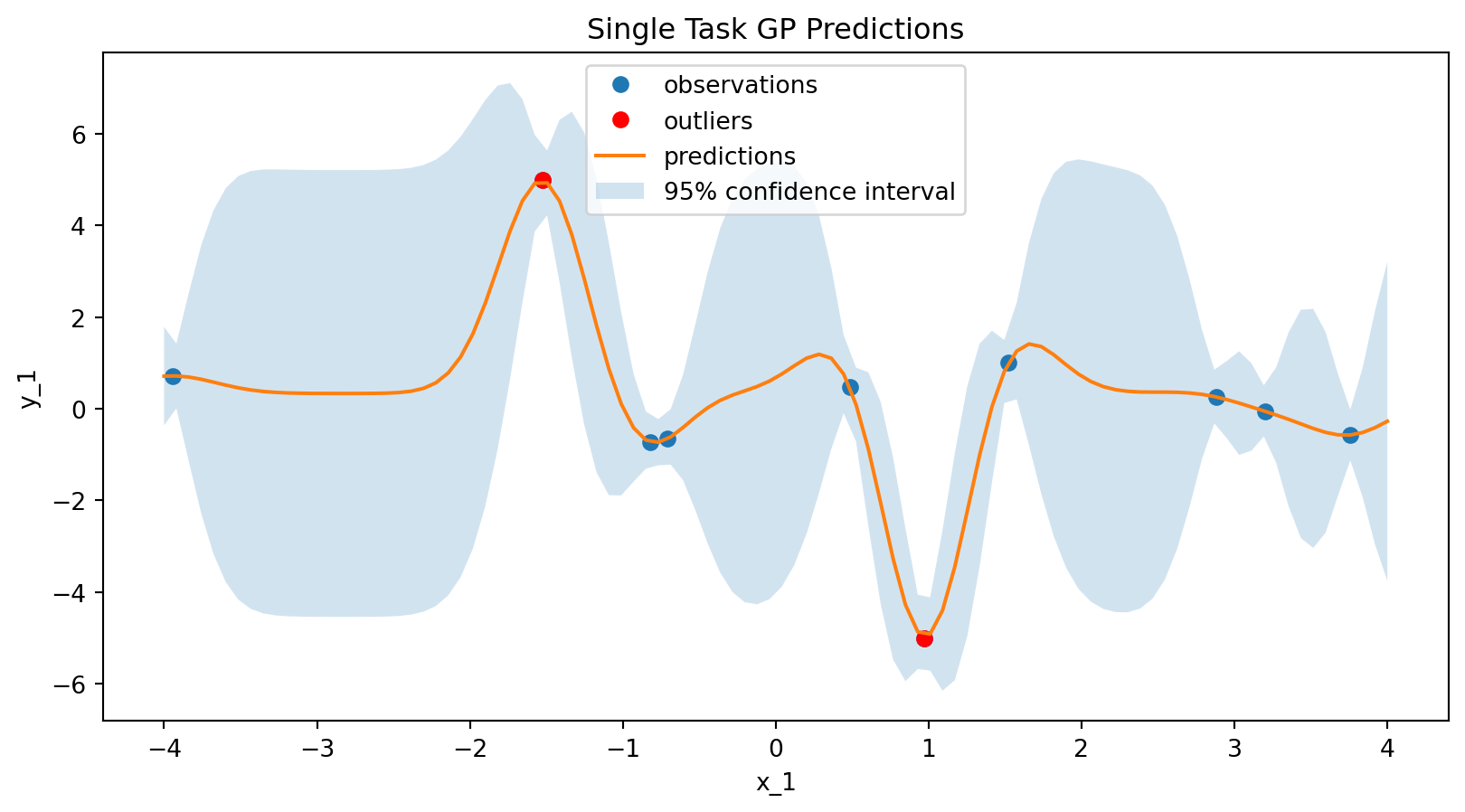
### Testing a SingleTaskGP
```{python}
stgp_data_model = SingleTaskGPSurrogate(
    inputs=input_features,
    outputs=output_features,
)

stgp_model = surrogates.map(data_model=stgp_data_model)
stgp_model.fit(experiments)
stgp_predictions = stgp_model.predict(x)
```
```{python}
# plot the surrogate
plt.figure(figsize=(10, 5))
plt.plot(experiments["x_1"], experiments["y_1"], "o", label="observations")

# plot the outliers in red
plt.plot(
    experiments["x_1"].iloc[:2],
    experiments["y_1"].iloc[:2],
    "ro",
    label="outliers",
)

plt.plot(x["x_1"], stgp_predictions["y_1_pred"], label="predictions")
plt.fill_between(
    x["x_1"],
    stgp_predictions["y_1_pred"] - 2 * stgp_predictions["y_1_sd"],
    stgp_predictions["y_1_pred"] + 2 * stgp_predictions["y_1_sd"],
    alpha=0.2,
    label="95% confidence interval",
)
plt.xlabel("x_1")
plt.ylabel("y_1")
plt.title("Single Task GP Predictions")
plt.legend()
plt.show()
```
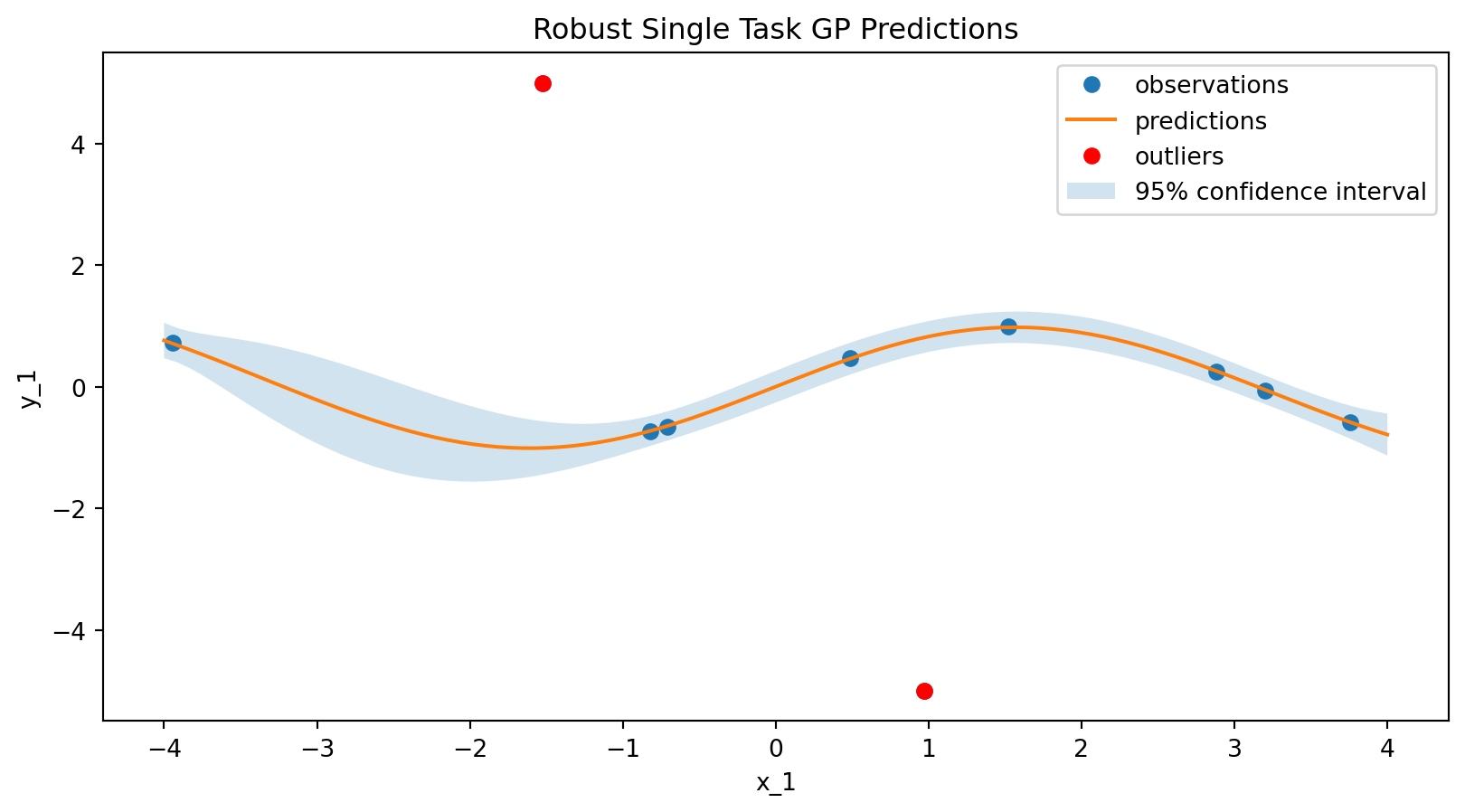
### Testing the Robust GP
```{python}
data_model = SingleTaskGPSurrogate.robust(input_features, output_features)

model = surrogates.map(data_model=data_model)
model.fit(experiments)
predictions = model.predict(x)
```
```{python}
# plot the surrogate
plt.figure(figsize=(10, 5))
plt.plot(experiments["x_1"], experiments["y_1"], "o", label="observations")
plt.plot(x["x_1"], predictions["y_1_pred"], label="predictions")

# plot the outliers in red
plt.plot(
    experiments["x_1"].iloc[:2],
    experiments["y_1"].iloc[:2],
    "ro",
    label="outliers",
)

plt.fill_between(
    x["x_1"],
    predictions["y_1_pred"] - 2 * predictions["y_1_sd"],
    predictions["y_1_pred"] + 2 * predictions["y_1_sd"],
    alpha=0.2,
    label="95% confidence interval",
)
plt.xlabel("x_1")
plt.ylabel("y_1")
plt.title("Robust Single Task GP Predictions")
plt.legend()
plt.show()
```
### Returning data point specific noise values $\rho$
```{python}
model.predict_outliers(experiments)
```
### Plotting the data point specific noise values
```{python}
# Get the outlier scores (rho) from the robust GP model
outlier_scores = model.predict_outliers(experiments)

# Plot the surrogate predictions
plt.figure(figsize=(10, 5))
plt.plot(experiments["x_1"], experiments["y_1"], "o", label="observations")
plt.plot(x["x_1"], predictions["y_1_pred"], label="predictions")

# plot the outliers in red
plt.plot(
    experiments["x_1"].iloc[:2],
    experiments["y_1"].iloc[:2],
    "ro",
    label="outliers",
)

# Plot sqrt(rho) as error bars on the observations
plt.errorbar(
    experiments["x_1"],
    experiments["y_1"],
    yerr=outlier_scores["y_1_rho"].values,
    fmt="none",
    ecolor="orange",
    alpha=0.7,
    label="rho",
)

plt.fill_between(
    x["x_1"],
    predictions["y_1_pred"] - 2 * predictions["y_1_sd"],
    predictions["y_1_pred"] + 2 * predictions["y_1_sd"],
    alpha=0.2,
    label="95% confidence interval",
)
plt.xlabel("x_1")
plt.ylabel("y_1")
plt.title("Robust Single Task GP Predictions with sqrt(rho) errorbars")
plt.legend()
plt.show()
```
### Obtaining the full model trace
```{python}
def bmc_plot(bmc_support_sizes: Tensor, bmc_probabilities: Tensor) -> None:
    cmap = plt.colormaps["viridis"]
    bar_width = 1
    plt.title("Model Evidence")
    for i, ss in enumerate(bmc_support_sizes):
        color = cmap((1 - (len(bmc_support_sizes) - i) / (2 * len(bmc_support_sizes))))
        plt.bar(ss, bmc_probabilities[i], color=color, width=bar_width)

    i = bmc_probabilities.argmax()
    map_color = cmap((1 - (len(bmc_support_sizes) - i) / (2 * len(bmc_support_sizes))))
    plt.bar(
        bmc_support_sizes[i],
        bmc_probabilities[i],
        color=map_color,
        label="MAP",
        edgecolor="black",
        linewidth=1.5,
        width=bar_width,
    )

    support_prior = torch.exp(-bmc_support_sizes / model.model.prior_mean_of_support)
    support_prior = support_prior / support_prior.sum()
    plt.plot(bmc_support_sizes, support_prior, "D", color="black", label="Prior", ms=2)

    plt.xlabel(
        f"Support Size (Prior = Exponential(mean={model.model.prior_mean_of_support:.1f}))"
    )
    plt.ylabel("Posterior Marginal Likelihood (%)")
    plt.legend(loc="upper right")
```
```{python}
data_model = SingleTaskGPSurrogate.robust(input_features, output_features)
data_model.likelihood.cache_model_trace = True

model = surrogates.map(data_model=data_model)
model.fit(experiments)
predictions = model.predict(x)
```
```{python}
figsize = (6, 4)
fig = plt.figure(dpi=100, figsize=figsize)
bmc_plot(model.model.bmc_support_sizes.detach(), model.model.bmc_probabilities.detach())
```