Not every objective can be read off a number line. Sometimes the only signal available is a comparison: a taste panel says cake A is nicer than cake B, a chemist judges one crystallisation cleaner than another, a user clicks one layout over another. The quantity actually being compared — a latent utility — is never observed directly.
BoFire’s PairwiseGPSurrogate learns that latent utility from pairwise comparison data. It wraps BoTorch’s PairwiseGP, a Gaussian process whose likelihood models the probability that one design is preferred over another.
This tutorial fits a PairwiseGPSurrogate to synthetic preference data and checks that it recovers the hidden utility.
Imports
import warningsimport numpy as npimport pandas as pdfrom matplotlib import pyplot as pltfrom scipy.stats import kendalltauimport bofire.surrogates.api as surrogatesfrom bofire.data_models.domain.api import Inputs, Outputsfrom bofire.data_models.features.api import ContinuousInput, ContinuousOutputfrom bofire.data_models.surrogates.api import PairwiseGPSurrogatewarnings.filterwarnings("ignore")rng = np.random.default_rng(42)
/opt/hostedtoolcache/Python/3.12.15/x64/lib/python3.12/site-packages/torch/jit/_script.py:1491: FutureWarning: `torch.jit.script` is deprecated. Please switch to `torch.compile` or `torch.export`.
  warnings.warn(
A synthetic preference problem
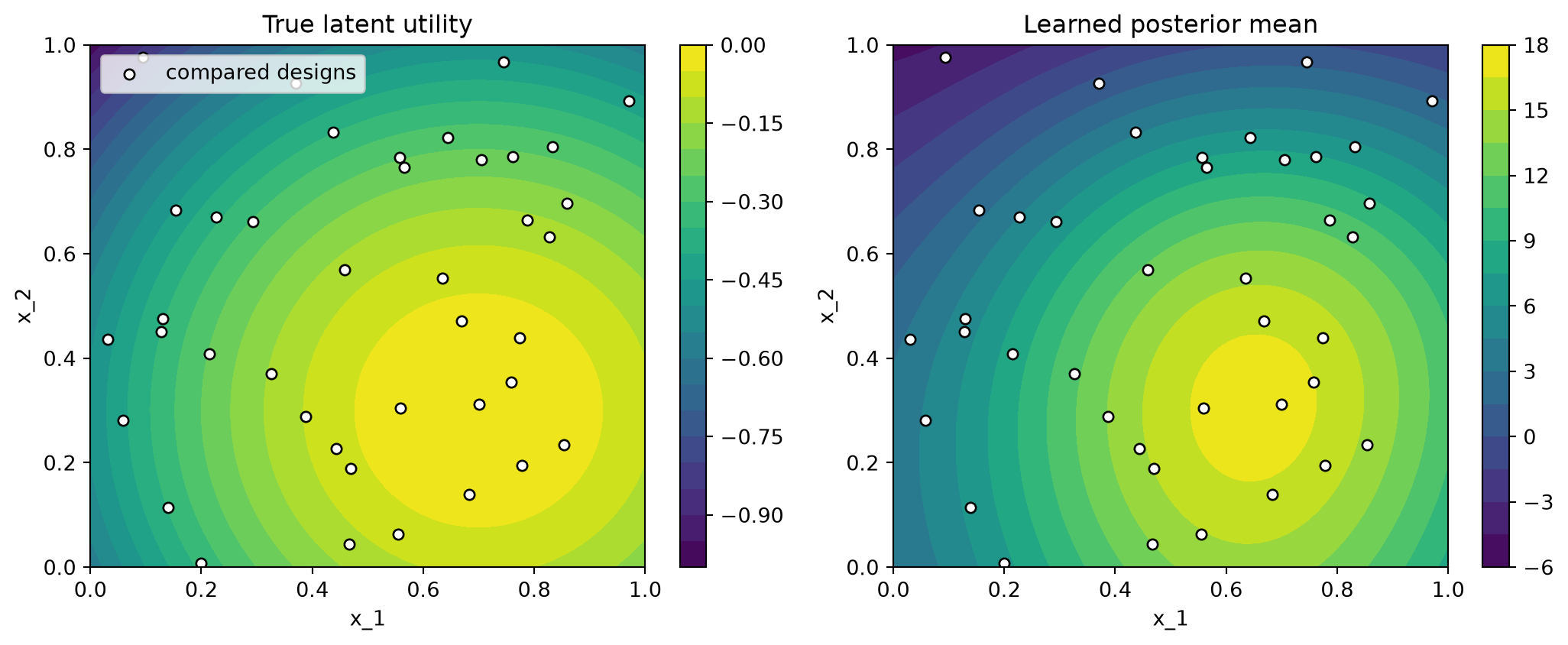
We work on a two-dimensional input space. The latent utility — the thing an expert implicitly scores when they pick a winner — is a smooth bump that peaks near (0.7, 0.3). In a real preference experiment this function is unknown; we define it here only so we can check what the surrogate learned.
def latent_utility(X: np.ndarray) -> np.ndarray:"""Ground-truth utility. Unobserved in a real preference experiment.""" peak = np.array([0.7, 0.3])return-np.sum((X - peak) **2, axis=-1)
We draw a handful of candidate designs and give each a unique labcode — the identifier BoFire uses to link a design to the comparisons it appears in.
Now we simulate an expert comparing random pairs of designs. The expert prefers whichever design has the higher latent utility, but their judgement is noisy, so they occasionally pick the worse one.
def make_comparisons(n_comparisons: int) -> pd.DataFrame: rows = []for _ inrange(n_comparisons): i, j = rng.choice(n_candidates, size=2, replace=False)# noisy utilities -> the expert occasionally prefers the worse design u_i = latent_utility(X[i]) + rng.normal(scale=0.05) u_j = latent_utility(X[j]) + rng.normal(scale=0.05) winner, loser = (i, j) if u_i > u_j else (j, i)# record the winner in slot A or B at random: the *sign* of# `preference` carries the label, not which slot the winner sits inif rng.random() <0.5: rows.append((labcodes[winner], labcodes[loser], 1.0)) # A preferredelse: rows.append((labcodes[loser], labcodes[winner], -1.0)) # B preferredreturn pd.DataFrame(rows, columns=["labcode_A", "labcode_B", "preference"])preferences = make_comparisons(n_comparisons=120)preferences.head()
labcode_A
labcode_B
preference
0
design_26
design_38
1.0
1
design_04
design_15
1.0
2
design_35
design_20
1.0
3
design_09
design_05
1.0
4
design_13
design_04
1.0
Setting up the surrogate
A PairwiseGPSurrogate needs an input space and exactly one output — the latent utility it will infer.
predict returns the posterior mean (utility_pred) and standard deviation (utility_sd) of the latent utility on new designs. Pairwise data pins down the ranking of designs, not the absolute utility values — the GP recovers utility only up to an arbitrary scale and offset — so we score it with the Kendall-Tau rank correlation against the true utility.
Kendall-Tau rank correlation vs. true utility: 0.894
A correlation close to 1 means the surrogate ranks unseen designs almost exactly as the latent utility would. We can see this directly by plotting the learned posterior mean next to the ground truth.
Both surfaces peak in the same region: from comparisons alone, the surrogate has located where utility is highest. The absolute contour values differ — pairwise learning identifies the latent utility only up to a monotone transform — but the ranking, which is what matters for optimization, is recovered.
The preference encoding
The preferences DataFrame must have exactly these three columns:
column
meaning
labcode_A
first design in the comparison (must appear in experiments)
labcode_B
second design in the comparison (must appear in experiments)
preference
sign marks the winner: > 0 → A preferred, < 0 → B preferred
Only the sign of preference is used — its magnitude is currently ignored. A preference of exactly 0 denotes a tie; tied rows are dropped with a warning. Because the slot (A vs. B) is just bookkeeping, swapping labcode_A with labcode_B and flipping the sign of preference describes the very same comparison and yields the same fit.
Where to go next
PairwiseGPSurrogate is the modelling building block for preference-based Bayesian optimization: combine it with an acquisition function such as BoTorch’s Expected Utility of the Best Option (EUBO) to decide which pair of designs to put in front of the expert next.
Source Code
---title: Preference Learning with the Pairwise GPjupyter: python3---Not every objective can be read off a number line. Sometimes the only signalavailable is a *comparison*: a taste panel says cake A is nicer than cake B, achemist judges one crystallisation cleaner than another, a user clicks onelayout over another. The quantity actually being compared — a latent *utility* —is never observed directly.BoFire's `PairwiseGPSurrogate` learns that latent utility from pairwisecomparison data. It wraps BoTorch's `PairwiseGP`, a Gaussian process whoselikelihood models the probability that one design is preferred over another.This tutorial fits a `PairwiseGPSurrogate` to synthetic preference data andchecks that it recovers the hidden utility.## Imports```{python}import warningsimport numpy as npimport pandas as pdfrom matplotlib import pyplot as pltfrom scipy.stats import kendalltauimport bofire.surrogates.api as surrogatesfrom bofire.data_models.domain.api import Inputs, Outputsfrom bofire.data_models.features.api import ContinuousInput, ContinuousOutputfrom bofire.data_models.surrogates.api import PairwiseGPSurrogatewarnings.filterwarnings("ignore")rng = np.random.default_rng(42)```## A synthetic preference problemWe work on a two-dimensional input space. The *latent utility* — the thing anexpert implicitly scores when they pick a winner — is a smooth bump that peaksnear `(0.7, 0.3)`. In a real preference experiment this function is unknown; wedefine it here only so we can check what the surrogate learned.```{python}def latent_utility(X: np.ndarray) -> np.ndarray:"""Ground-truth utility. Unobserved in a real preference experiment.""" peak = np.array([0.7, 0.3])return-np.sum((X - peak) **2, axis=-1)```We draw a handful of candidate designs and give each a unique `labcode` — theidentifier BoFire uses to link a design to the comparisons it appears in.```{python}n_candidates =40X = rng.random((n_candidates, 2))labcodes = [f"design_{i:02d}"for i inrange(n_candidates)]experiments = pd.DataFrame(X, columns=["x_1", "x_2"])experiments["labcode"] = labcodesexperiments.head()```Now we simulate an expert comparing random pairs of designs. The expert preferswhichever design has the higher latent utility, but their judgement is noisy, sothey occasionally pick the worse one.```{python}def make_comparisons(n_comparisons: int) -> pd.DataFrame: rows = []for _ inrange(n_comparisons): i, j = rng.choice(n_candidates, size=2, replace=False)# noisy utilities -> the expert occasionally prefers the worse design u_i = latent_utility(X[i]) + rng.normal(scale=0.05) u_j = latent_utility(X[j]) + rng.normal(scale=0.05) winner, loser = (i, j) if u_i > u_j else (j, i)# record the winner in slot A or B at random: the *sign* of# `preference` carries the label, not which slot the winner sits inif rng.random() <0.5: rows.append((labcodes[winner], labcodes[loser], 1.0)) # A preferredelse: rows.append((labcodes[loser], labcodes[winner], -1.0)) # B preferredreturn pd.DataFrame(rows, columns=["labcode_A", "labcode_B", "preference"])preferences = make_comparisons(n_comparisons=120)preferences.head()```## Setting up the surrogateA `PairwiseGPSurrogate` needs an input space and exactly one output — the latentutility it will infer.```{python}inputs = Inputs( features=[ ContinuousInput(key="x_1", bounds=(0.0, 1.0)), ContinuousInput(key="x_2", bounds=(0.0, 1.0)), ])outputs = Outputs(features=[ContinuousOutput(key="utility")])surrogate_data = PairwiseGPSurrogate(inputs=inputs, outputs=outputs)surrogate = surrogates.map(surrogate_data)```Unlike a standard surrogate, `fit` takes *two* DataFrames — the designs and thecomparisons between them:```{python}surrogate.fit(experiments, preferences)surrogate.is_fitted```## Inspecting the learned utility`predict` returns the posterior mean (`utility_pred`) and standard deviation(`utility_sd`) of the latent utility on new designs. Pairwise data pins down the*ranking* of designs, not the absolute utility values — the GP recovers utilityonly up to an arbitrary scale and offset — so we score it with the Kendall-Taurank correlation against the true utility.```{python}test_X = rng.random((500, 2))test_df = pd.DataFrame(test_X, columns=["x_1", "x_2"])predictions = surrogate.predict(test_df)true_utility = latent_utility(test_X)tau = kendalltau(predictions["utility_pred"], true_utility).correlationprint(f"Kendall-Tau rank correlation vs. true utility: {tau:.3f}")```A correlation close to 1 means the surrogate ranks unseen designs almost exactlyas the latent utility would. We can see this directly by plotting the learnedposterior mean next to the ground truth.```{python}fig, axes = plt.subplots(1, 2, figsize=(11, 4.5))grid = np.linspace(0, 1, 60)gx, gy = np.meshgrid(grid, grid)grid_df = pd.DataFrame({"x_1": gx.ravel(), "x_2": gy.ravel()})true_grid = latent_utility(grid_df.to_numpy()).reshape(gx.shape)pred_grid = surrogate.predict(grid_df)["utility_pred"].to_numpy().reshape(gx.shape)for ax, surface, title in [ (axes[0], true_grid, "True latent utility"), (axes[1], pred_grid, "Learned posterior mean"),]: contour = ax.contourf(gx, gy, surface, levels=20, cmap="viridis") ax.scatter( X[:, 0], X[:, 1], c="white", edgecolors="black", s=25, label="compared designs", ) ax.set(xlabel="x_1", ylabel="x_2", title=title) fig.colorbar(contour, ax=ax)axes[0].legend(loc="upper left")plt.tight_layout()plt.show()```Both surfaces peak in the same region: from comparisons alone, the surrogate haslocated where utility is highest. The absolute contour values differ — pairwiselearning identifies the latent utility only up to a monotone transform — but the*ranking*, which is what matters for optimization, is recovered.## The preference encodingThe `preferences` DataFrame must have exactly these three columns:| column | meaning ||---|---||`labcode_A`| first design in the comparison (must appear in `experiments`) ||`labcode_B`| second design in the comparison (must appear in `experiments`) ||`preference`| sign marks the winner: `> 0` → A preferred, `< 0` → B preferred |Only the **sign** of `preference` is used — its magnitude is currently ignored.A `preference` of exactly `0` denotes a tie; tied rows are dropped with awarning. Because the slot (A vs. B) is just bookkeeping, swapping `labcode_A`with `labcode_B` and flipping the sign of `preference` describes the very samecomparison and yields the same fit.## Where to go next`PairwiseGPSurrogate` is the modelling building block for preference-basedBayesian optimization: combine it with an acquisition function such as BoTorch's*Expected Utility of the Best Option* (EUBO) to decide which pair of designs toput in front of the expert next.